How to Write a Compound RFQ: 12 Lines That Get an Accurate Quote
An accurate compound quote is decided by 12 lines of information. Here is the RFQ template — what to write on each line, and what goes wrong when a line is missing.
An accurate quote is not produced by the supplier's price list; it is produced by your RFQ. When a compound inquiry carries the 12 lines below, we can match a grade, check it against your part, and quote a price that survives the first mold trial. When lines are missing, every supplier fills the gaps with their own assumptions — and you end up comparing quotes for different materials. Copy the template, fill what you can, and mark the rest "to be confirmed". A partial RFQ with honest blanks beats a polished one with silent guesses.
If the material lines are vague, every quote prices a different compound
Line 1 — Grade or base resin. Name the polymer family and, if you have it, the grade: "PA66", "PBT", "PEI". Without this line, "engineering plastic granules" can be quoted as anything from a commodity resin to a high-temperature compound at ten times the price.
Line 2 — Filler type and content. Glass fiber 30%, carbon fiber, mineral, or unfilled — and the percentage. Filler content drives stiffness, shrinkage and price more than any other single variable. If you do not know the content of the grade you use now, say so; it can be checked by burn-off test on a sample of your current material.
Line 3 — Flame rating and wall thickness. "UL94 V-0" alone is not a specification. V-0 at 3.0 mm and V-0 at 0.8 mm are different compounds. Write the rating together with the thinnest wall of the part, and add glow-wire or CTI requirements if your end standard asks for them.
Line 4 — Color. Natural, black, or a matched color — and whether the part is visible. Color decides which flame retardant systems are even possible (red phosphorus, for example, is dark colors only) and whether a color masterbatch or a pre-colored compound is the right route.
If the part lines are missing, the quote prices the wrong risks
Line 5 — Key property targets. Two or three numbers that the part actually lives or dies by: tensile strength, impact at low temperature, HDT, CTI. A short target list lets the supplier pick the grade that meets your real requirement instead of the most expensive one that meets an imagined requirement.
Line 6 — Application and the part itself. "Connector housing, outdoor, 2 mm wall, snap-fit latch" tells an engineer more than a page of general description. Service environment — heat, UV, moisture, chemicals, electrical load — is what turns a generic grade into the right grade. A drawing or even a photo of the part helps more than another paragraph.
If the commercial lines are missing, the quote cannot be compared
Line 7 — Quantity per order and estimated annual volume. Compound pricing, stocking and lead time all depend on volume. You are not committing to the annual figure; you are telling the supplier which supply model to price — spot stock, scheduled production, or a custom run made to specification through our partner lines.
Line 8 — Packaging. Standard 25 kg bags, moisture-proof bags, big bags, or pallet requirements. For hygroscopic materials such as nylon, packaging is a quality line, not a logistics detail: it decides how much drying your molding shop has to do.
Line 9 — Destination port or delivery point. Freight can move the landed cost of a compound more than a grade change. A quote without a destination is a price for material standing in the supplier's warehouse.
Line 10 — Document requirements. List what your quality system needs up front: TDS, COA per lot, RoHS or REACH declarations, third-party test reports. Documents available on request are easy to supply when they are asked for at RFQ stage — and slow to chase after the goods ship.
If the baseline lines are missing, the trial starts from zero
Line 11 — The grade you use now. The single most useful line in the RFQ. A current grade name — or its TDS — gives the supplier a verified baseline to match or improve, instead of a theoretical target. If the current grade is a brand grade, we will propose a comparable alternative and show the data side by side; we are not affiliated with the brand owner, and the comparison is there for you to judge.
Line 12 — Sample needs. Say how much trial material you need and what you will do with it: mold trial, assembly check, aging test. Our samples start from 5 kg — enough to mold real parts — with stock samples dispatched in 1–3 working days and custom trial compounds in 10–20 working days after the specification is confirmed.
A filled example: PA66 GF30 for a solar junction box housing
- Grade / base resin: PA66, glass fiber reinforced
- Filler: glass fiber, 30%
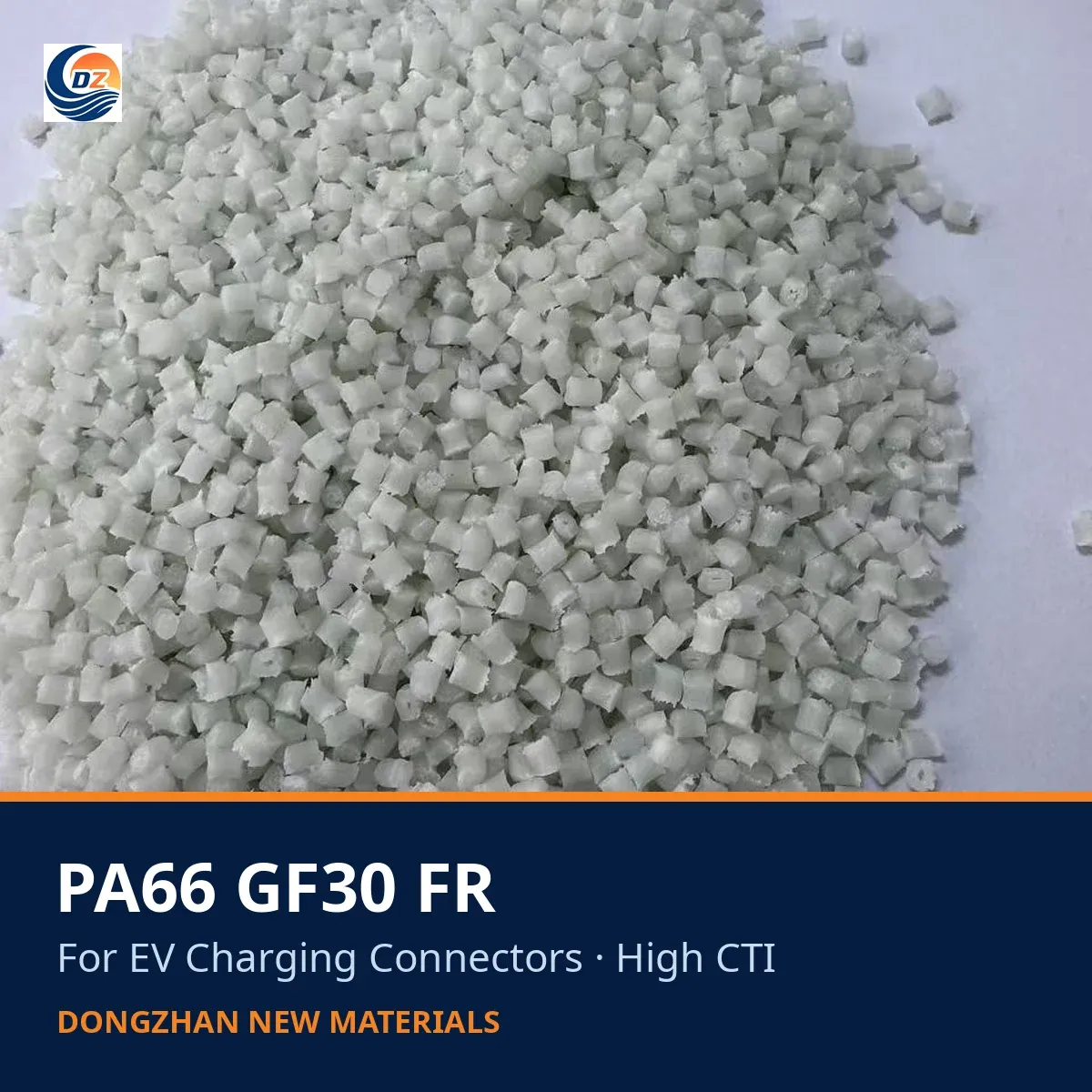
- Flame rating: halogen-free, UL94 V-0 at 1.6 mm; CTI ≥600 V
- Color: black, UV-stabilized for outdoor use
- Key targets (typical / reference values): tensile strength 165 MPa, flexural modulus 8,800 MPa, HDT 240 °C, service range −40 to +120 °C
- Application: photovoltaic junction box housing, outdoor, gasket-sealed
- Quantity: trial first; annual volume to be confirmed after approval
- Packaging: 25 kg moisture-proof bags
- Destination: to be confirmed with the order
- Documents: TDS and RoHS on request; third-party test reports on request
- Current grade: a weather-resistant PA66 GF30 solar grade (TDS attached)
- Sample: 5 kg for mold trial and assembly check
This example matches the specification of our weather-resistant PA66 GF30 grade for solar junction box housings — the values in line 5 are the typical reference values published on that page, and the full TDS is available on request. For a structural automotive RFQ, the same 12 lines work with different content: our PA66 GF25 grade for front-end carriers and automotive housings is the kind of baseline such an RFQ is priced against. If you are still deciding which parts of the specification matter most for outdoor electrical parts, our checklist for material selection for EV charging connectors and solar junction boxes walks through the reasoning. The full range is on our products page.
Send us your 12 lines
Fill the template with what you know and send it over — blanks are fine, guesses are what cost time. We will reply with a matched grade, its TDS, and a 5 kg sample offer: stock samples in 1–3 working days, custom trial compounds in 10–20 working days after specification confirmation. Samples are charged, with freight collect.
FAQ
Q: Can you quote from just a grade name?
A: We can quote a comparable compound, but the price is only firm once filler content, flame rating at your wall thickness, and quantity are known. A grade name plus its TDS is the fastest starting point.
Q: We don't know the exact glass fiber content of our current material. Can you still quote?
A: Yes. Send a small piece or a molded part of the current material; the filler content can be verified by burn-off, and the mechanical baseline can be taken from its TDS if you have it.
Q: Do you charge for samples?
A: Yes — samples start from 5 kg and are charged, with freight collect. In return, the trial material is the actual compound proposed for production, not a showroom substitute.